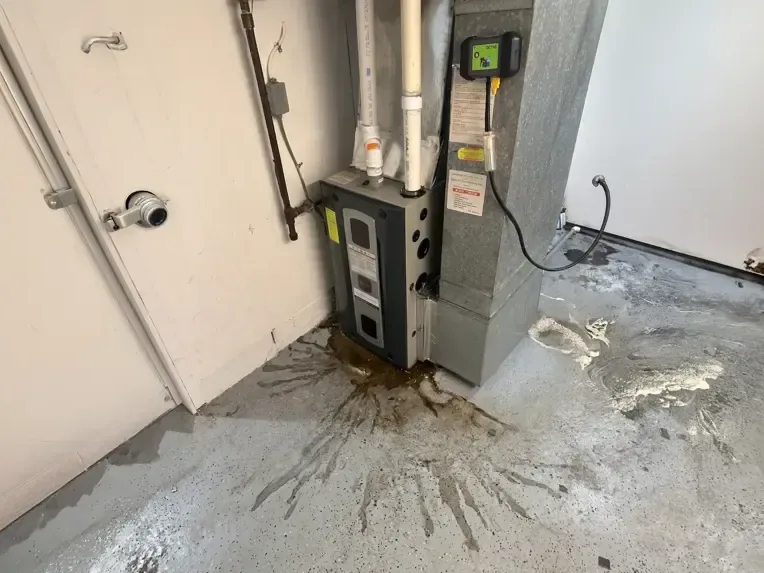
The town grew from 2,569 residents in 2000 to 14,549 in 2020, so most homes are subdivision builds from the last 25 years, and attic air handlers are common. When the condensate drain clogs or the pan rusts through, the water soaks the insulation and then the ceiling below. This post shows how to tell an air conditioner leak from other causes and what the cleanup involves.
Key takeaways
- An air conditioner pulls moisture out of humid air, and that water leaves through a condensate drain that can clog.
- A stain that grows on hot, humid days and eases when the system is off points at the air handler more than the roof.
- Turn the system off at the thermostat first, because running it keeps feeding the leak.
- Wet insulation and drywall are opened and dried, and a stain that is only painted over comes back.
- About 54 inches of Mid-South rain a year and long humid summers keep cooling systems working hard.
How a condensate drain overflow starts
The cooling coil in an air handler pulls moisture out of the air. That water collects in a pan and leaves through a small drain pipe.
Dust, algae and sludge build up inside that pipe over a cooling season. Once it clogs, the pan fills and spills.
Many units carry a float switch that is meant to cut power when the pan fills. If that switch is missing or has failed, the system keeps running and the spill keeps growing.
- A clogged drain pipe that backs water into the pan
- A rusted or cracked drain pan
- A drain pipe that has sagged or come apart at a joint
- A float switch that failed and never shut the system off
Why attic air handlers are the usual suspect here
Subdivision homes from the last 25 years often keep the air handler in the attic. Condensate overflows from those units are one of the common water failures in town.
The water drops onto insulation first, which hides the leak. By the time a ceiling stain appears, a good deal of insulation and drywall can already be wet.
Summer humidity matters too. A system that runs for long stretches makes more condensate, so a marginal drain fails in July instead of in January.
Heavy rain adds to the confusion, since a storm can fall on the same week a drain clogs. That is why the timing of the stain is the best clue.
Telling an AC leak from other causes
Several leaks stain ceilings, but the timing differs. Watching when the stain grows narrows the source.
Signs that point to the air handler
The stain sits below the attic unit, often in a hallway or closet ceiling.
- The stain grows on hot, humid days, even with no rain
- The stain stops growing when the system is off for a day
- Water drips near the air handler or its drain pan
Signs that point to the roof
The stain appears after rain and sits near an exterior wall or the roofline. A storm leak is described under roof leak water damage.
Signs that point to a plumbing leak
The stain sits below a bathroom or laundry area and keeps growing whether or not the system is running or it has rained. A rising water bill is another clue.
What to do right away
The goal is to stop new water and protect what is below. A bulging ceiling can hold a lot of water, so it is better opened in a controlled way than poked.
Wet insulation also sits close to wiring and light fixtures. Do not switch on a light fixture under a wet or sagging ceiling.
- Set the thermostat to off so the system stops making condensate.
- Switch off the air handler at its disconnect or breaker if the attic access is safe.
- Place a bucket and towels under any drip, and move furniture out of the way.
- Photograph the stain, the drip and the drain pan if it can be seen safely.
- Keep people out from under a bulging or sagging section of ceiling.

What the cleanup does
A crew handling AC condensate leak water damage starts by taking water out of the insulation and pulling the wet pieces. The soaked section of ceiling is opened so the joist bays can dry.
Condensate starts as clean water, but it picks up dust and insulation fibers, so the wet materials are not left in place.
The air conditioning technician repairs the drain separately. Cleanup and the repair are best scheduled together, and the ceiling work is covered under ceiling leak water damage.
What gets removed
The crew takes out what cannot dry in place:
- Insulation that has soaked through
- Ceiling drywall that is stained, soft or sagging
- Any trim or fixtures below that are wet
How drying is checked
Air movers and a dehumidifier then run until readings match a dry reference. Moisture meters and a thermal camera show what is still wet, so the equipment stays until the framing and the new drywall area read dry.
How long a leak can run unnoticed
An attic unit sits out of sight, so a slow overflow can run for weeks before anyone sees a stain. The first sign is often a faint ring or a musty smell in a closet.
By then the insulation has held water for a long time. That is why a small stain can lead to a larger opening than the owner expects.
Preventing a repeat
Most overflows build up slowly, which makes them preventable. A short routine before each cooling season lowers the odds.
- Have the condensate drain cleared before summer starts
- Ask the technician about a float switch that cuts power when the pan fills
- Look in the attic after storms and at the start of hot weather
- Check the ceiling below the unit whenever a new stain or smell shows up
Questions
Why is a ceiling stain brown?
Water carries dust and tannins out of insulation and the paper face of drywall, and it leaves a brown ring where it dries. The ring grows each time the ceiling gets wet again.
Can the air conditioner keep running during a leak?
No. A running system keeps making condensate, so the leak keeps growing. Turn it off at the thermostat and the disconnect until the drain is cleared.
Does painting over the stain fix the problem?
No. Paint hides the mark but leaves wet insulation and drywall behind it, and the stain tends to return along with a musty smell.
How does a homeowner know the drain is clogged?
Standing water in the drain pan, water backing up at the drain opening or a pan that overflows on hot days are the usual signs. An air conditioning technician can confirm it and clear the pipe.
Is condensate water safe to touch?
It starts clean, but it collects dust, insulation fibers and growth from the pan on the way down. Gloves are sensible, and wet insulation should be removed, not reused.
Who repairs the drain, and who dries the ceiling?
An air conditioning technician repairs the drain, pan or switch. A water damage crew handles extraction, removal of wet materials and drying, and the two jobs are easier when planned together.