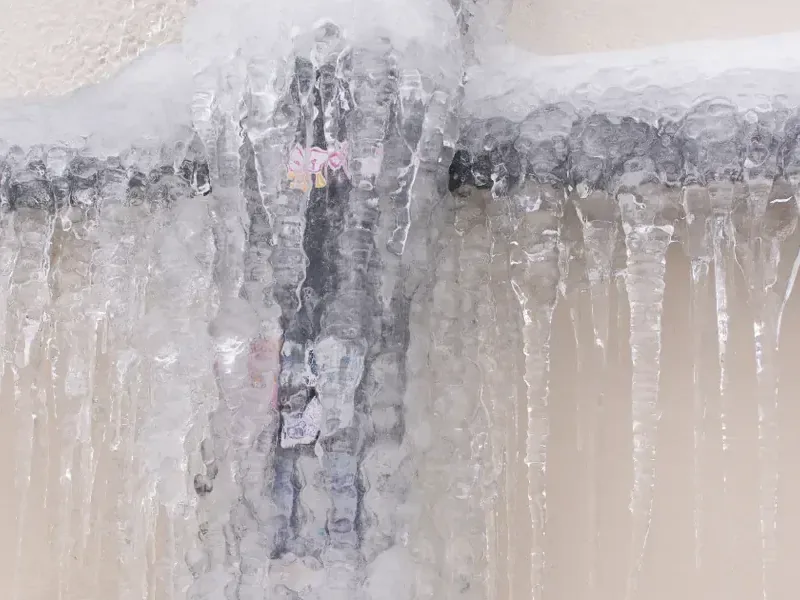
Freezing weather finds the weak spots in a plumbing system quickly. City Public Works has published a list of the places where pipes freeze first and what to do about it. This post uses that advice, explains what happens after a pipe splits and describes how cleanup works.
Key takeaways
- Public Works lists crawl spaces, unheated rooms, outside walls and plumbing routed through an attached garage as places pipes are vulnerable to freezing.
- The advice is to let a small trickle run overnight, wrap exposed pipes and know where the main shut-off valve is.
- If a pipe freezes or bursts, shut the water off immediately.
- Outdoor backflow devices get a hot box with electric heat tracing.
- A frozen pipe often shows its damage only after the thaw.
Where city Public Works says pipes freeze first
The Munford Public Works Department lists the places where pipes are vulnerable to freezing. Each one has a common feature: cold air reaches the pipe and little heat reaches the space.
Crawl spaces and garages are open to outside air, outside walls sit against the cold, and unheated rooms get little warmth from the rest of the house. A pipe in any of them can freeze while the living areas stay comfortable.
- Crawl spaces
- Unheated rooms
- Outside walls
- Plumbing routed through an attached garage
The city's advice before a freeze
Public Works gives a short list of steps that cost little and take little time. Doing them before the cold arrives is the cheapest protection a household has.
The City of Munford Public Works Department collects and distributes water, so the household's own main shut-off valve is the part a resident controls. Finding it before winter matters more than any other step on the list.
- Let a small trickle run overnight
- Wrap exposed pipes
- Know where the main shut-off valve is
- Give outdoor backflow devices a hot box with electric heat tracing
- Know which pipes sit in the spaces on the city's list
A frozen pipe is not yet a flood
A frozen pipe can sit for hours without leaking, because the ice itself plugs the break. The flood starts when the ice melts.
Before it splits
A faucet that gives only a trickle or nothing during a freeze points to ice in the pipe. Opening the tap and warming the area gently can thaw it without a split.
Never use an open flame on a pipe. If the pipe is in a wall or crawl space and cannot be reached, shut the water off at the main valve.
A pipe that has frozen once can freeze again, so wrapping it or warming the space afterward is part of the fix.
After it splits
Public Works says to shut the water off immediately if a pipe freezes or bursts. That stops the flow while the water is still draining out of the pipe.
The water that is already inside the house still has to be extracted and the structure dried.
If the break is in a spot that cannot be reached, such as inside a wall, the main valve is the only control, and a crew can open the wall to find the wet area.
What a burst pipe does inside a house
A split pipe sends water into the cavity where it burst. The route depends on where the pipe sat.
A crew handling burst pipe water damage follows the water from the split to the lowest point it reached.
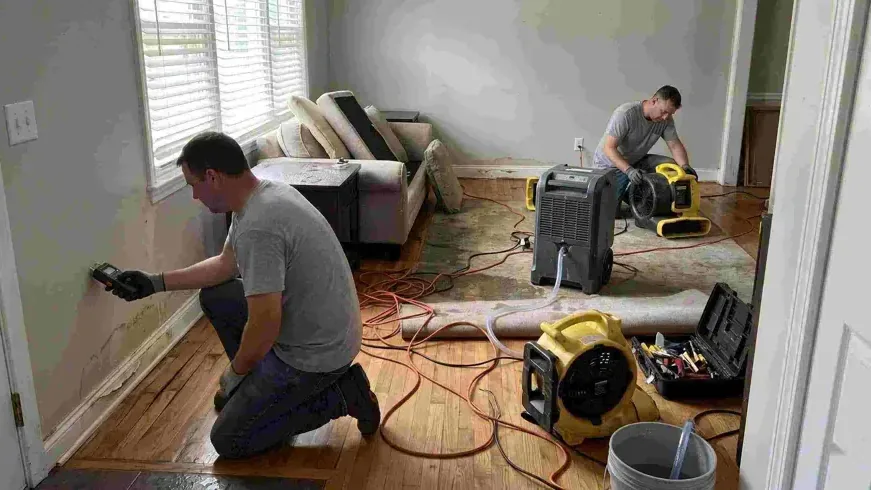
After the water is out, the crew opens the wet cavity so air can reach the framing. Moisture readings show when the cavity is dry enough to close.
Because the water travels, the wet area is often larger than the stain. Moisture mapping finds the edges.
- A pipe in an outside wall wets the wall cavity, insulation and baseboard
- A pipe in the attic soaks insulation and the ceiling below
- A pipe in an attached garage wets the slab, stored items and the shared wall
- A pipe under the floor wets insulation, joists and the subfloor
Crawl space and garage cleanup
Where a house has a crawl space, water from a split pipe collects below the floor. Wet insulation is pulled and the joists and subfloor are dried with air movers and dehumidifiers.
A garage needs a different approach. Water spreads across the slab, so extraction comes first, and then the wall bottoms shared with the house are opened and dried.
The work is described under frozen pipe water damage.
The crew works through the same checks in each space:
For a wider look at the service, the main page on burst pipe water damage covers the same process.
Foam wrap on exposed pipes is a low-cost fix after the cleanup, and the crew notes any pipe that sits close to an outside wall.
- Extraction of standing water and soaked insulation
- Moisture readings in joists, subfloor and wall bottoms
- Air movers and dehumidifiers placed to move air through the cavity
- Daily readings until each area matches a dry reference
What the winter record shows
City offices and buildings closed on February 16, 2021 because of a winter storm, with dangerously cold temperatures expected through most of that workweek.
That closure is the confirmed local record. It does not count burst pipes in homes, so no damage claim is made for that week.
Checking the house after a freeze
A split pipe can hide until the thaw. A short walk-through after the cold passes catches leaks before they spread.
Local help with water damage restoration can look at any spot that seems off.
A freeze that returns after the first thaw can split a pipe a second time, so the walk-through is repeated after each cold spell.
- Look for damp walls, stained ceilings and soft baseboard
- Listen for running water when every fixture is off
- Check water pressure at each tap
- Watch the water meter for movement when nothing is running
- Look at the crawl space or garage walls for drips and wet insulation
Questions
Where do pipes freeze first in a home?
Public Works lists crawl spaces, unheated rooms, outside walls and plumbing routed through an attached garage.
What should be done when a pipe freezes or bursts?
Public Works says to shut the water off immediately. Water already in the house then has to be extracted and the structure dried.
Does leaving a faucet dripping help?
The city advises letting a small trickle run overnight, which keeps water moving through pipes in vulnerable spots.
How are outdoor backflow devices protected?
The city advises a hot box with electric heat tracing for outdoor backflow devices.
Why does damage appear after a thaw?
Ice can plug a split pipe. When it melts, the water runs through the break, and the leak shows for the first time.
Who controls the water supply to a home?
The City of Munford Public Works Department collects and distributes water, and each home has its own main shut-off valve. Knowing where that valve is lets a household stop the flow quickly.