
Most homes here are newer, with a median build year of 2000, but a pipe can burst at any age. A split fitting or a hard freeze can send water through a ceiling or wall quickly. This post covers what the city says to do, the steps that stop the water, and how cleanup follows once the supply is off.
Key takeaways
- The city calls a burst pipe or water heater leak inside a home or business an emergency.
- The MLGW 24-hour emergency hotline sends crews who shut off the water supply.
- The home's main valve is often the fastest way to stop water, if it can be found and turned.
- Shutting off the water does not remove what is already in the walls, ceiling and floor.
- Clean supply water is the easiest water to dry, but only while it is removed quickly.
What the city says about a burst pipe
The City of Lakeland treats a burst pipe or a water heater leak inside a home or business as an emergency. Its pages send water shutoff emergencies to MLGW, whose 24-hour emergency hotline sends crews who shut off the water supply.
That step stops water at the source. It does not take out the water already inside the walls, ceiling or floor.
A restoration crew picks up where the shutoff ends. The two jobs are separate, and both are needed after a serious burst.
First steps while the water is running
The aim is to stop the flow, keep electricity away from water and save what can be saved. These steps come in roughly this order:
- Close the home's main water valve if it can be reached safely.
- Open the lowest faucet to let the pipes drain.
- Switch off power to wet rooms at the panel only if the panel is dry.
- Move rugs, electronics and papers out of the path of the water.
- Photograph the source and the spread before cleanup begins.
- Use the MLGW hotline if the water cannot be stopped at the home.
Why pipes burst and where the water goes
A burst pipe rarely stays where it starts. The cause and the location of the split decide the route the water takes.
Common causes
Burst pipes have a handful of familiar causes. Knowing which one applies helps the plumber find the failure faster.
- A hard freeze that splits a pipe in an attic, an outside wall or an unheated space
- A fitting or connector that wears out and lets go under pressure
- A supply hose that bursts behind an appliance
- A pipe damaged during a remodel or by a nail through a wall
Down through walls and ceilings
A split in an attic or wall pipe sends water down through insulation, ceiling drywall and wall cavities before a stain shows. The city's own freeze advice names attic piping, including pipes to water heaters, as pipes worth protecting.
A ceiling that sags or bulges is already holding water and needs care before anyone stands under it.
Across floors
On a floor, water moves to the lowest point, under baseboards and into cabinet bases. A small flow left for a long time can soak a large area.
Water under a hard floor can lift boards and spread into the wall bottoms on every side of the room.
Extraction and drying once the water is off
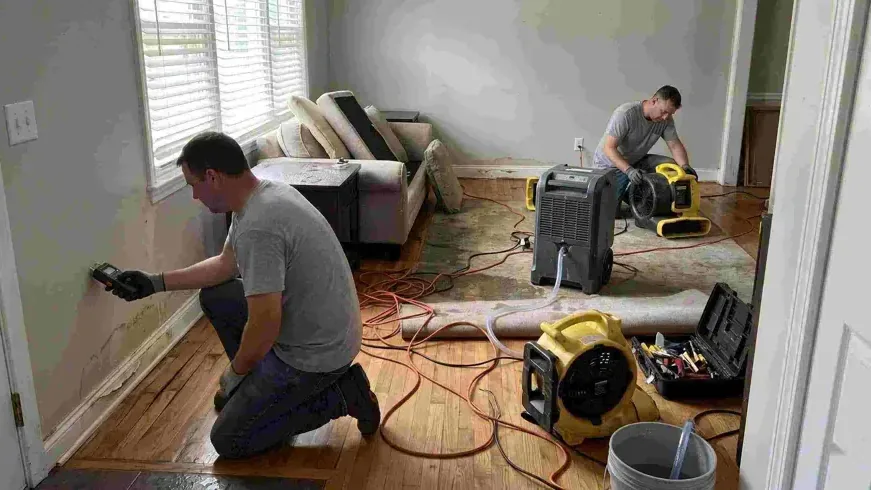
A crew handling burst pipe water damage begins with water extraction, pulling standing water off hard floors and out of carpet and pad.
Next come moisture readings in walls and ceilings, then openings cut where wet insulation or drywall is holding water. Air movers and dehumidifiers run until the readings match a dry reference.
Supply water starts out clean, which makes it the easiest water to dry. That window closes as drywall and insulation stay wet.
What the crew checks
Hidden water is the main risk after a burst, so the checks go beyond what is visible:
- Moisture readings in walls on both sides of the leak path
- A thermal camera scan of ceilings and wall bases
- Insulation in the attic or wall cavity above the wet area
- Cabinet bases and the subfloor under flooring
What a burst does to common materials
Different materials react to a burst in different ways, which is why the crew checks each one before choosing what stays.
- Drywall soaks water up from the bottom and can soften within a short time
- Insulation holds water and loses its value until it is replaced
- Carpet and pad can often be extracted and dried if the water was clean and the response was prompt
- Hardwood and laminate can cup or lift when water gets underneath
Winter timing and the city's freeze plan
The city's Snow and Ice Control Plan covers December through March each year, and that is the season when frozen pipes turn into frozen pipe water damage.
City advice for cold nights is simple: run at least one faucet at a thin stream, leave sink cabinet doors open and insulate outside pipes. A pipe that froze but has not yet split can still be saved if the water is shut off and the pipe is thawed slowly.
Who handles which part
A burst pipe involves three separate jobs, and each belongs to a different trade.
A local team that works on water damage restoration in the city can coordinate the drying with the plumber's schedule.
- MLGW: shutting off the water supply when the home cannot stop it
- A plumber: finding and repairing the failed pipe or fitting
- A restoration crew: extraction, removal of wet materials and drying
Documenting the loss
Clear notes help later, whether the repair is a small patch or a large rebuild. They take only a few minutes while the details are fresh.
The crew adds a moisture log and photos as drying proceeds, so the file shows where the water started, what it reached and when each area read dry.
- Photos of the failed pipe and the first wet areas
- The time the water was shut off
- A list of wet furniture, flooring and belongings
- The failed part itself, kept in a bag for the plumber
Questions
Who should be called first when a pipe bursts in the city?
The city says a burst pipe inside a home is an emergency and sends shutoff emergencies to the MLGW 24-hour hotline. If the home's own main valve works, closing it stops the water faster.
Does shutting off the water solve the problem?
It stops new water only. Water already in the walls, ceiling and floor keeps soaking drywall and insulation until it is extracted and dried.
Is burst pipe water treated as contaminated?
Supply water starts out clean. It can still pick up dirt from insulation and surfaces, and wet materials left in place get worse over time, so prompt removal matters.
Can a burst pipe happen in a newer home?
Yes. A failed fitting, a hard freeze or a worn part can split a pipe in a house of any age.
Should the failed pipe be thrown away?
Keep it until the plumber has seen it. The break shows how the pipe failed, which helps the repair and the notes on the loss.