Structural Drying and Dehumidification in Lakeland, TN
Wet walls, floors and ceilings keep releasing moisture after the water is gone. Drying equipment in Lakeland homes pulls it out, and daily readings show when the structure has reached dry.
(888) 849-5796Start the dehumidifier plan- LGR dehumidifiers
- Injection drying for walls
- Daily readings
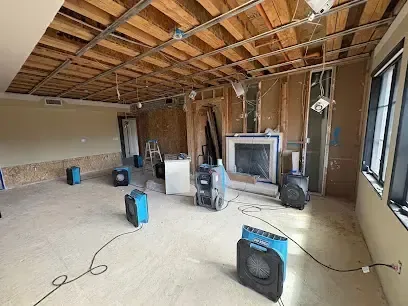
Structural Drying and Dehumidification: what to do first
- Stop new water
Make sure the source is fixed and extraction is finished before the drying plan is judged.
- Leave equipment alone
Do not move or switch off air movers and dehumidifiers, since placement follows the moisture map.
- Keep doors closed
Closed doors and windows hold the drying room at the right conditions.
- Expect daily checks
A technician returns to read moisture and adjust the equipment.
How the crew handles structural drying and dehumidification
Class and category
IICRC S500 classes a loss by how much water and how porous the materials are, and that sets the equipment plan.
Walls and ceilings
Injection drying pushes dry air into closed cavities, so drywall can stay up when readings allow.
Floors and concrete
Mats and desiccant units pull moisture from hardwood and concrete, which dry slowly.
What does structural drying and dehumidification cost in Lakeland, TN?
One or two rooms cost $1,000 to $3,000. Several rooms or a ceiling run $3,000 to $8,000, and a whole floor or Class 4 loss $8,000 to $15,000+.
One or two rooms
- Air movers and one dehumidifier
- Several days of drying
- Daily moisture logs
Rooms or a ceiling
- Several LGR units running
- Injection drying for walls
- Psychrometric records
Whole floor or Class 4
- Desiccant drying
- Hardwood and concrete mats
- Long monitoring
Ranges only, not a quote. The drivers are the water category, the square footage, the material class and how fast drying started. For a planning number, try the water damage cost calculator.
The median home in Lakeland was built in 2000, and about 79 percent of occupied homes are owner-occupied. Drying is the stage that decides whether a wet room is repaired or rebuilt, whatever the age of the house.
What the equipment does
Air movers push dry air across wet surfaces while LGR dehumidifiers pull the moisture out of the air. Together they dry framing, subfloor and drywall far faster than open windows or box fans could. Placement matters as much as the machine count, because air has to reach wet surfaces and cavities rather than circulate in an empty room.
- A thermal camera and meters map the wet areas first.
- Equipment is placed to follow that map.
- Readings decide every adjustment.
Why newer homes dry differently
About 75 percent of occupied homes in town were built in 1990 or later. Newer houses tend to be built tighter, so moisture that is not pulled out stays in cavities and finishes, and drying plans lean on dehumidifiers rather than ventilation. With most homes owner-occupied, the people deciding whether to open a wall are usually the ones living behind it, so clear readings matter.
How drying ends
Drying ends when readings match a dry reference, not on a set day. Extraction comes first, as covered in water extraction, and many jobs begin with burst pipe cleanup or appliance leak water damage. A drying log with temperature, humidity and moisture numbers is the record insurers ask for most often.
The four stages of structural drying and dehumidification
- 01
Map the moisture
Meters and a thermal camera mark every wet surface so equipment is placed with a plan.
- 02
Set the equipment
Air movers, dehumidifiers and any injection ports go in, and the room is closed to hold conditions.
- 03
Monitor each day
Temperature, humidity and moisture readings are logged and equipment is adjusted.
- 04
Confirm dry
Equipment comes out only when readings match the dry reference, and the logs go into the claim file.
Structural drying and dehumidification across Lakeland and nearby towns
Drying equipment is placed across ZIP 38002, including Woodbridge, Oakwood Grove, Estates of Chambers Chapel, Winstead Farms, Arcadia and the townhomes at The Lake District.
The same service nearby: structural drying and dehumidification in Arlington, Bartlett, Oakland.
38002
Structural Drying and Dehumidification questions in Lakeland, TN
How long does structural drying take?
Most losses need three to five days, though hardwood, thick insulation or a whole floor can take longer. Daily readings, not a calendar, decide the end.
Can drywall be dried instead of replaced?
Often yes. If it is clean water and the drywall has not softened, injection drying can save it. Sewage or long-standing water changes that.
Why are dehumidifiers louder than expected?
LGR units run a heated cycle to pull water vapor out of the air, so they hum and warm the room. That is how the structure dries.
Will drying raise the electric bill?
Yes, because several machines run around the clock for days. Insurers commonly consider that cost part of the loss, so keep the equipment log.
What separates Class 2 from Class 4?
Class 2 means a large area is wet with moderate absorption, while Class 4 involves dense materials such as hardwood or concrete that hold moisture deeply and need specialty drying.
Can windows be opened to help?
Usually not. Outside air adds humidity, so the room is kept closed and the dehumidifiers do the work.
Ready to dry it out?
Describe the wet rooms and materials, and the equipment plan is built around the moisture map before the visit.